Indoor Cat Depression: Signs, Causes & How Enrichment Helps
Can cats get depressed? Indoor cats can become withdrawn and flat from boredom, stress, or change. Here are the signs, the real causes, and how enrichment helps.
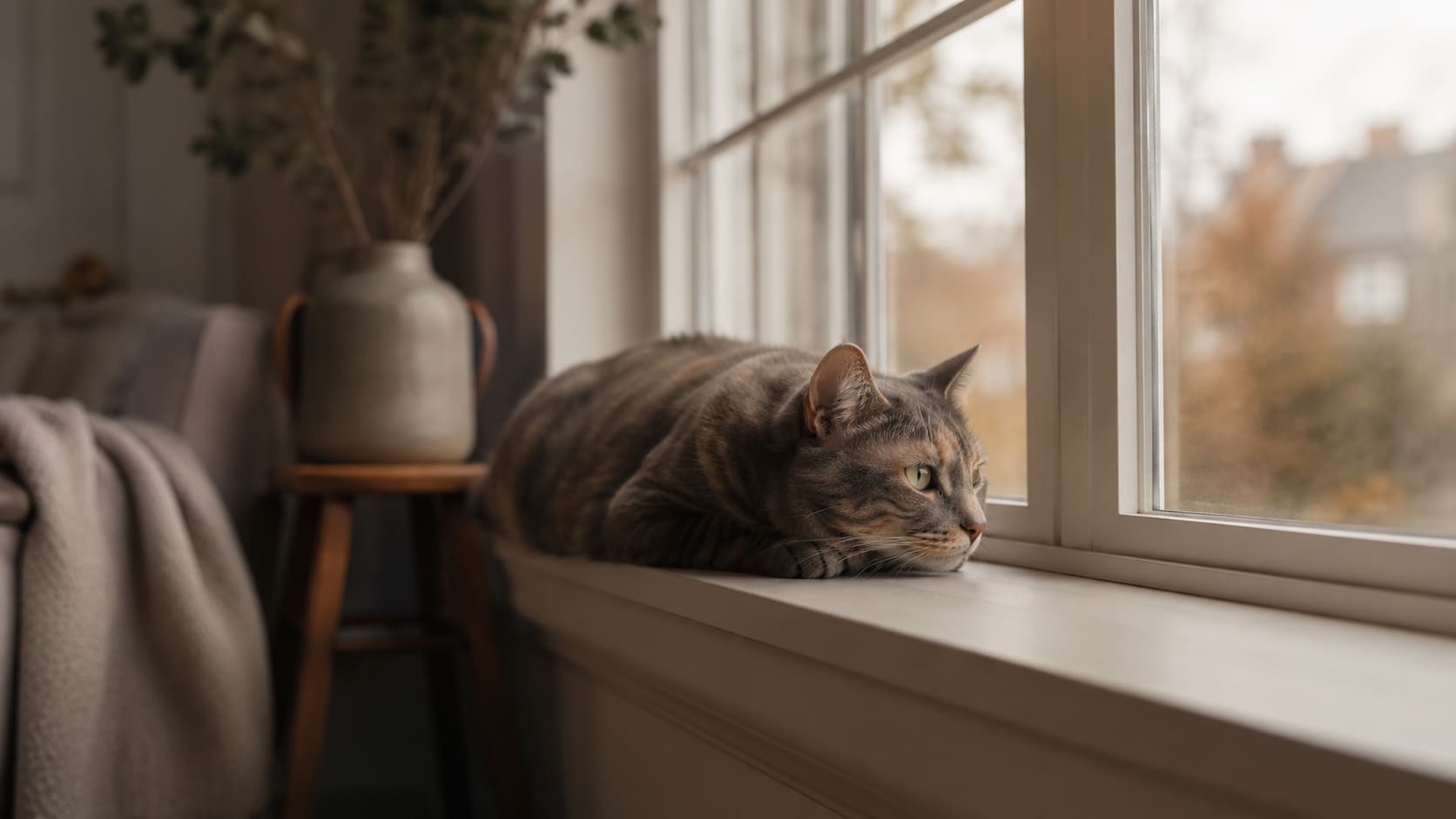
Your cat used to greet you at the door, patrol the windows, and pester you at dinner. Lately they mostly sleep, tucked in the same spot, uninterested in the toys and the food and you. Something feels off, and “depressed” is the word that comes to mind.
It is a fair word to reach for. Cats do not experience clinical depression the way people do, but they absolutely can become withdrawn, flat, and low in response to their circumstances, boredom, stress, loss, or a big change in their world. For an indoor cat, whose entire environment is the few rooms you provide, the quality of that environment has an outsized effect on mood. A life with nothing to hunt, watch, or solve can dim a cat the same way a grey month can dim a person.
The important caveat first, then the signs, the causes, and what actually helps.
Rule Out Illness First, Always
This matters more than anything else on this page: the signs of a “depressed” cat and the signs of a sick cat are nearly identical. Lethargy, hiding, not eating, and withdrawal are how cats show pain and illness, because their instinct is to mask weakness until it is severe.
So the first stop for a suddenly flat cat is not a new toy. It is a vet. Rule out the medical causes, dental pain, thyroid problems, kidney issues, and many others, before you treat the problem as behavioral. We cover how to think through this in bored, lonely, or sick.
With a clean bill of health, you can look at the environment.
The Signs of a Low or Withdrawn Cat
Once illness is ruled out, these are the patterns that point to an environmental or emotional cause:
- Sleeping much more than usual, even for a cat, with little interest in the awake hours.
- Loss of interest in play, food, or favorite people, a flatness where there used to be engagement.
- Hiding or retreating to out-of-the-way spots far more than before.
- Changes in grooming, either neglecting it or over-grooming to the point of bald patches.
- Changes in vocalization, unusually quiet, or unusually mournful.
One of these alone may mean little. Several together, especially after a change in the household, are worth acting on.
What Actually Causes It
Environment-driven low mood in indoor cats usually traces back to one of a few causes:
- Chronic boredom and understimulation, the slow grind of empty days with no outlets.
- A major change, a move, a new baby, a new pet, a schedule shift, or the loss of a companion animal or person.
- Stress and insecurity, conflict with another pet, an unpredictable environment, or no safe high-ground to retreat to.
- Reduced interaction, less attention and play than the cat was used to.
The thread running through all of these is a loss of control and engagement. The fix, accordingly, is to give both back.
Rebuild the Routine
Cats are deeply reassured by predictability. A withdrawn cat often perks up simply from a reliable daily rhythm, meals, play, and attention at consistent times. Routine tells a cat the world is safe and knowable, which is the ground everything else is built on.
Start here before anything fancy: same meal times, a short play session at the same point each day, predictable quiet and predictable interaction.
Refill the Day With Things to Do
A flat cat needs reasons to re-engage, gently at first. The goal is to rebuild the hunt-watch-solve loop that a dull environment stripped away.
What helps: A window with a view is one of the kindest first steps, passive, low-demand stimulation a low cat can take in without effort. A cat window perch gives them a comfortable front-row seat to the outside world, and a tray of cat grass nearby offers a gentle, safe sensory activity to re-engage with. For the wider menu, see 20 indoor cat enrichment ideas.
Rekindle Play Gently
A depressed cat will not leap into a vigorous hunt on day one. Start small and low-pressure: brief sessions with a toy that triggers the hunting instinct, ending in an easy catch so your cat wins and rediscovers that play feels good.
What helps: A wand toy like the Go Cat Da Bird is the most reliable trigger for re-engaging a flat cat, because its prey-like movement reaches the instinct even when motivation is low. Keep sessions short and let your cat succeed. If they stay uninterested in all play, why your cat won’t play with toys covers what else might be in the way.
Lower the Stress
If change or conflict is behind the low mood, reducing the underlying stress is part of the cure. Calming aids and secure spaces help a cat feel safe enough to come back out.
What helps: A Feliway diffuser releases a synthetic version of the facial pheromone cats use to mark a space as safe, which can take the edge off stress during a transition or conflict. Pair it with safe high perches and quiet retreats so your cat always has a secure place to be.
Give It Time, and Know When to Escalate
Environment-driven low mood usually lifts as the days fill with routine, stimulation, and security, but it is not always instant. Give the changes a couple of weeks to take hold while you watch for steady improvement.
If your cat does not improve, or gets worse, go back to the vet, and ask specifically about behavioral causes and whether a referral to a veterinary behaviorist is warranted. Persistent withdrawal that does not respond to enrichment deserves professional eyes.
The encouraging reality is that most indoor cats labeled “depressed” are responding to a fixable environment, not a permanent state. Give a flat cat reasons to watch, hunt, and feel secure again, on a routine they can count on, and most of them come back. For help confirming boredom is in the mix, start with signs your cat is bored.
Trying to tell whether your cat is genuinely improving week to week? We’re building CatPlay, a simple app for tracking your cat’s daily play, appetite, and behavior so you can see the trend instead of guessing.
Sources
This article cites 3 sources in the text. They are linked below.
- Common Cat Behavior Issues (ASPCA)
- Feline Environmental Needs and Enrichment (MSPCA-Angell)
- What Your Cat Needs to Feel Secure (Cat Friendly Homes)
Common questions
Can indoor cats actually get depressed?
Cats do not get clinical depression the way humans do, but they can become withdrawn, flat, and low in response to boredom, stress, loss, or major change. The signs are real and worth taking seriously, even if the label is not a perfect match for the human condition.
What are the signs of a depressed cat?
Common signs include sleeping far more than usual, loss of interest in play and food, hiding, reduced grooming or over-grooming, changes in vocalization, and a general flatness. Because these overlap heavily with illness, a vet visit should come first to rule out a medical cause.
How do I help a depressed indoor cat?
Once a vet has ruled out illness, the core fixes are restoring routine, adding enrichment and structured play, reducing stress with calming aids and safe spaces, and rebuilding positive interaction. Most environment-driven low moods lift as the cat's days fill with things to do and a sense of security returns.
The Cat Behavior Decoder
A free PDF with the body language cues and behavior patterns worth noticing first.
No spam. Unsubscribe anytime. We respect your inbox.