7 Signs Your Cat Is Bored (And What to Do About It)
Bored cats are not always quiet. They may overeat, bite, meow, scratch, or seem flat. Here are the signs and the enrichment fixes that help.
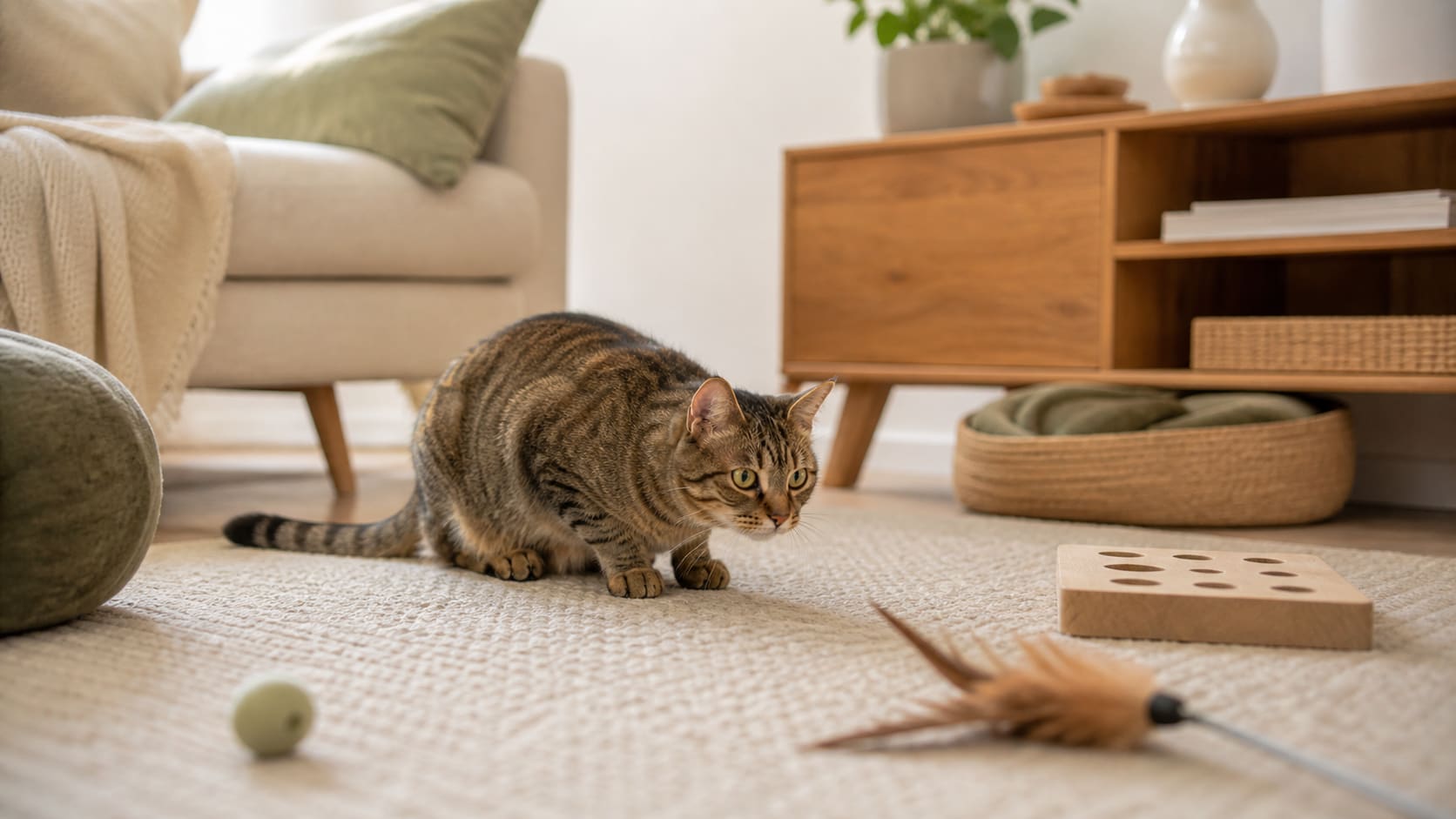
Most people picture a bored cat as one sitting in a window, staring blankly at nothing.
That cat exists. But boredom in cats more often looks like a cat that is annoying, destructive, clingy, or suddenly rough.
Indoor cats live in stable, predictable environments. That is comfortable, but it can also be under stimulating for an animal built around movement, novelty, and hunting. When the environment has nothing to offer, the brain often creates its own activity.
Here is what that can look like.
1. Overeating or Obsessing Over Food
A cat that finishes her meal and immediately acts starving is not always truly hungry.
Food can become the most exciting event of the day. When there is nothing else to focus on, your cat may circle the kitchen, meow at the bowl, or beg because mealtime is the only reliable stimulation available.
Food fixation can be boredom in disguise.
What helps: Move at least part of the meal away from a bowl. A foraging toy like the PetSafe SlimCat turns food into a short hunt and gives your cat something to work through.
2. Destructive Behavior Around the House
Scratching furniture, pulling at rugs, chewing plants, and pushing objects off surfaces can all come from the same place: your cat is making something happen.
That does not mean every destructive behavior is boredom. Scratching also marks territory and maintains claws. But if the behavior spikes when your cat has had a flat, inactive day, boredom is probably part of the pattern.
The deliberate nudge that sends your glass off the table is often a small experiment: What happens if I do this?
A bored cat will create stimulation when the room does not provide enough.
What helps: Add vertical space and texture. A stable Feandrea 56.3-Inch Cat Tree gives your cat a place to climb, scratch, perch, and watch the room from above. For the table version of this behavior, read why cats knock things off tables.
3. Excessive or Sudden Roughness
A cat that ambushes your feet, bites your hand, or launches into rough play is not necessarily aggressive by nature.
Predatory energy has to go somewhere. If your cat does not get enough chase, stalk, pounce, and catch through play, moving hands and ankles become convenient targets.
This is especially common in young cats and in homes where interactive play happens only when the cat starts causing trouble.
Rough play often means the hunting drive has no better job.
What helps: Schedule a wand session before the rough behavior usually appears. Go Cat Da Bird works well because the feather movement can trigger a full chase and catch sequence. If the roughness happens during petting, see why cats bite when petted.
4. Sleeping Much More Than Usual
Cats sleep a lot. Twelve to sixteen hours a day can be normal.
But a cat who sleeps nearly all day, ignores movement, and shows little interest in normal play may be showing something different from ordinary cat rest. Low stimulation can make a cat seem flat, especially when nothing in the environment changes from day to day.
Always treat sudden lethargy as medical first. If your cat is newly inactive, eating less, hiding, or acting different, call your vet.
If health checks out, low engagement can still be a boredom signal.
What helps: Add short bursts of passive enrichment while you are busy. PetFusion Ambush creates unpredictable feather movement under a cover, which can give some cats a reason to watch, stalk, and pounce.
5. Constant Meowing and Attention Seeking
There is a difference between a cat who chats and a cat who cannot settle.
If your cat follows you from room to room, vocalizes constantly, and only relaxes when you respond, boredom may be wearing the mask of neediness. In that pattern, you have become the main interesting thing in the environment.
Attention seeking often improves when the cat gets predictable stimulation before asking for it.
What helps: Initiate play before the meowing starts. End the session while your cat is still engaged, then offer food or a puzzle feeder. The interactive toy roundup has options for cats who need more owner led play and cats who need more solo activity.
6. Overgrooming or Repetitive Behaviors
Overgrooming can have medical causes, so do not treat it as boredom without a vet check.
That said, cats may lick, pace, or repeat small behaviors when they are stressed, under stimulated, or stuck in a predictable environment with too few choices. The pattern can look quiet, but it is still a sign that your cat’s day may not be meeting her needs.
Repetition is worth taking seriously, especially when it is new.
What helps: Add novelty in small doses. Rotate toys. Change feeding locations. Offer a paper bag, box, perch, or new scent to investigate. Our guide to indoor cat enrichment ideas gives simple options that do not require a full shopping list.
7. Batting at Things Without Really Playing
This one is subtle.
A bored cat might swat once, follow a toy for a second, then walk away. The play looks half hearted. It is not that your cat refuses all fun. It is that the movement pattern may not be strong enough to switch the hunting system on.
Sometimes you do not need a new toy. You need a better prey pattern.
Try movement that disappears and reappears, changes speed, hides under fabric, or pauses before darting away. Petstages Tower of Tracks can help some cats because the rolling balls move unpredictably without needing you to be present.
The Bigger Picture
Most indoor cat boredom improves with a few consistent changes.
Start with one daily structured play session. Add foraging to one meal. Give your cat somewhere to climb, scratch, hide, and watch the room.
The signs above do not require a complete life overhaul. They require noticing what is missing and adding the right kind of stimulation.
For a deeper routine, read indoor cat enrichment ideas. For feeding specifically, puzzle feeders are one of the highest impact additions most cat owners have not tried yet.
Noticing patterns in when your cat acts bored or restless? We’re building CatPlay, a simple app for tracking your cat’s daily play and behavior so you can see what’s working and what is not.
Sources
This article cites 3 sources in the text. They are linked below.
- Feline Environmental Needs and Enrichment (MSPCA-Angell)
- Setting Up the Environment for Success (FelineVMA)
- What Your Cat Needs to Feel Secure (Cat Friendly Homes)
Common questions
How do I know if my indoor cat is bored?
Common signs include food obsession, destructive behavior, attention seeking, play biting, overgrooming, restless meowing, or unusually low interest in normal activity.
Can boredom make a cat aggressive?
Boredom can make predatory energy spill into biting, ankle attacks, and rough play. That is not the same as a cat being mean. It usually means the hunting drive needs a better outlet.
What is the fastest way to help a bored cat?
Start with one daily wand play session and one foraging meal. Those two changes add movement and mental work without requiring a full home redesign.
The Indoor Cat Enrichment Starter Plan
A simple download with play, food puzzle, and routine ideas you can use this week.
No spam. Unsubscribe anytime. We respect your inbox.