Puzzle Feeders for Wet vs Dry Food + Mealtime Enrichment
Most puzzle feeders only work with kibble. Here is how to add mealtime enrichment for wet food too, plus the best puzzle feeders for dry, wet, and slow eating.
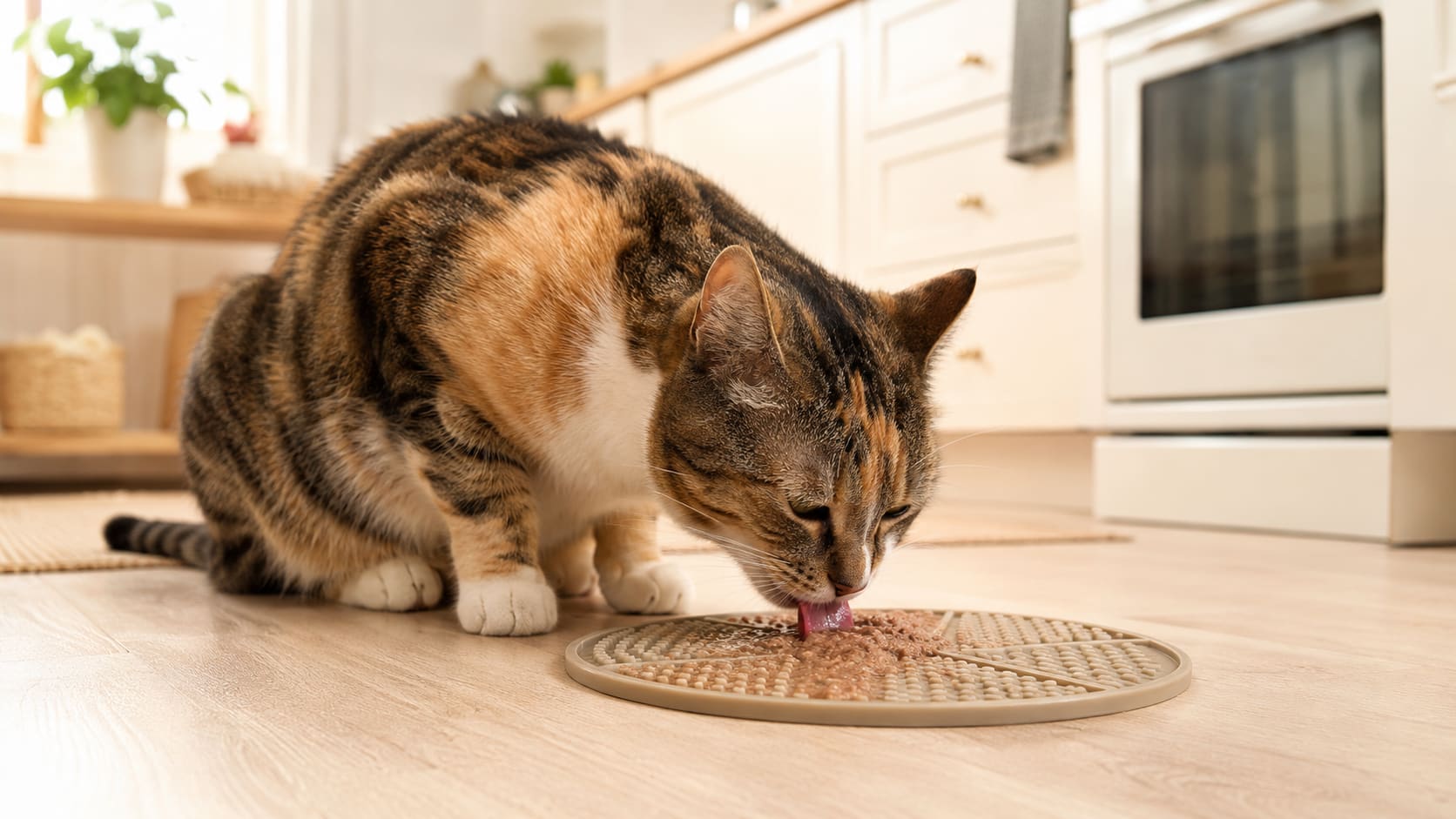
Puzzle feeders are one of the best upgrades you can give an indoor cat: they slow down gulpers, add real mental work, and rebuild the natural instinct to earn a meal instead of finding it waiting in a bowl. But there is a catch almost nobody mentions until you are standing in the kitchen holding a can.
Nearly every puzzle feeder on the market is built for dry food. Rolling balls, tip-and-spill towers, tube boards, they all rely on kibble that drops out cleanly. Try to load one with wet food and you get a smeared, frustrating mess. And since many cats are, rightly, fed at least partly on wet food for hydration and health, that leaves a real gap.
The good news is that mealtime enrichment for wet food is absolutely possible, it just uses a different set of tools. Here is how to puzzle-feed both kinds of food, and the best feeders for each.
Why Work-For-Food Matters at All
A bowl meal is over in under two minutes. A puzzle meal can stretch to ten or fifteen minutes of pawing, licking, and problem-solving, and that difference does three useful things: it slows fast eaters who otherwise gulp and vomit, it provides genuine mental stimulation, and it satisfies the deep instinct to work for food that a bowl quietly erases.
This is some of the most natural enrichment there is, which is why it shows up in nearly every mental stimulation plan. The only question is matching the tool to the food.
For Wet Food: Lick Mats Are the Answer
The workhorse of wet-food enrichment is the lick mat, a textured surface you spread food across so your cat has to lick it out of the grooves. A thirty-second portion of wet food becomes several minutes of focused, repetitive licking, which is both occupying and self-soothing.
It is also a great tool for anxious cats, since the licking action itself is calming, and for medication or topper delivery.
What helps: A LickiMat Slomo has deep grooves that hold wet food, pate, or a topper and make your cat work it out slowly. It suctions to the floor or a wall so your cat cannot simply flip it. For cats that need a little chase in the experience, the fish-shaped LickiMat Felix adds a different texture and shape to keep mealtime varied.
For Wet Food, Going Further: Trays and Molds
Beyond lick mats, any flat surface that makes wet food harder to reach adds enrichment. Silicone molds, ice-cube trays, and shallow muffin tins all turn a single blob into a dozen small “find and lick” portions spread across a surface.
You do not need to buy anything special here, this is squarely DIY territory. Spreading wet food thin across a clean tray, or pressing small dabs into a mold, gives the same work-for-it effect for free. Our DIY cat enrichment guide has more of these no-cost mealtime ideas.
For Dry Food: Rolling and Tipping Feeders
Kibble is where the classic puzzle feeders shine. A rolling treat ball makes your cat bat and chase a moving target that dispenses food as it goes, combining foraging with a bit of physical play, ideal for the morning meal right as you head out the door.
What helps: A PetSafe SlimCat is a simple, cheap, and effective rolling ball with an adjustable opening, so you can start easy and tighten it as your cat gets the hang of it. It is one of the most reliable first puzzle feeders for dry food.
For Clever or Fast Eaters: Stationary Puzzle Boards
Some cats solve a rolling ball in a day. For those cats, a stationary puzzle with multiple mechanisms, tubes, wells, and sliders, holds up far longer because it asks for different paw movements and a bit of strategy.
These also work for cats who do not chase a ball but will happily dig and fish for food in one spot.
What helps: A Catit Senses Digger stands kibble up in tall tubes your cat has to paw and dig the food out of, mimicking the act of fishing prey out of a burrow. It works for dry food and larger treats, and resists being “solved” the way a simple ball can be. For the full comparison of designs, see our guide to the best puzzle feeders for fast eaters.
How to Introduce Any Puzzle Feeder
The most common mistake is starting too hard, which teaches a cat the puzzle is not worth the effort. Set them up to win:
- Start on the easiest setting with a food your cat already loves.
- Make the first wins free, food sitting on top or barely tucked in, so your cat learns the puzzle pays out.
- Raise difficulty slowly, only once your cat is confident and successful.
- Drop back a level if they get frustrated or walk away. The aim is engaged, never defeated.
- Never let a puzzle stand between your cat and a needed meal. If in doubt, offer part of the food in a puzzle and part in a bowl while they learn.
A Simple Mealtime Plan
You do not need a cabinet full of feeders. A balanced setup for most cats:
- Morning (dry): part of the kibble meal in a rolling ball or puzzle board as you leave.
- Evening (wet): the wet portion spread on a lick mat or tray.
- Variety: rotate between two or three feeders so mealtime stays novel rather than routine.
Done this way, every meal becomes a small enrichment session, twice a day, every day, with no extra time from you. It is one of the highest-return habits in all of cat care: better digestion, a busier brain, and a cat that is working for dinner the way it was always meant to.
For where mealtime enrichment fits in the bigger picture, see 20 indoor cat enrichment ideas.
Want to see whether the new feeding routine is actually slowing your cat down and keeping them engaged? We’re building CatPlay, a simple app for tracking your cat’s daily eating and enrichment so you can fine-tune what works.
Sources
This article cites 3 sources in the text. They are linked below.
- Feline Environmental Needs and Enrichment (MSPCA-Angell)
- Food Puzzles for Cats (Cat Friendly Homes)
- Indoor Pet Initiative — Cats (The Ohio State University College of Veterinary Medicine)
Common questions
Can you use a puzzle feeder with wet food?
Yes, but not with the rolling ball and tube feeders designed for kibble. For wet food you want lick mats, silicone molds, flat tray puzzles, and spreadable surfaces that make a cat work the food out by licking rather than by rolling and dropping it.
Are puzzle feeders good for cats?
For most cats, yes. They slow down fast eaters, add mental stimulation, and rebuild the natural work-for-food instinct that a bowl removes. Start easy so your cat succeeds early, and never make a cat go hungry over a puzzle that is too hard.
How do I introduce a puzzle feeder?
Begin on the easiest setting with a food your cat loves, and make early wins simple, food sitting on top or barely hidden. Increase difficulty only once your cat is confident. If they give up or get frustrated, drop back a level. The goal is engaged, not defeated.
The Indoor Cat Enrichment Starter Plan
A simple download with play, food puzzle, and routine ideas you can use this week.
No spam. Unsubscribe anytime. We respect your inbox.