Why Does My Cat Knock Things Off Tables? (5 Reasons + How to Stop It)
Your cat isn't being a jerk. There are real behavior patterns behind why cats push things off tables. Here are 5 reasons and practical solutions that actually help.
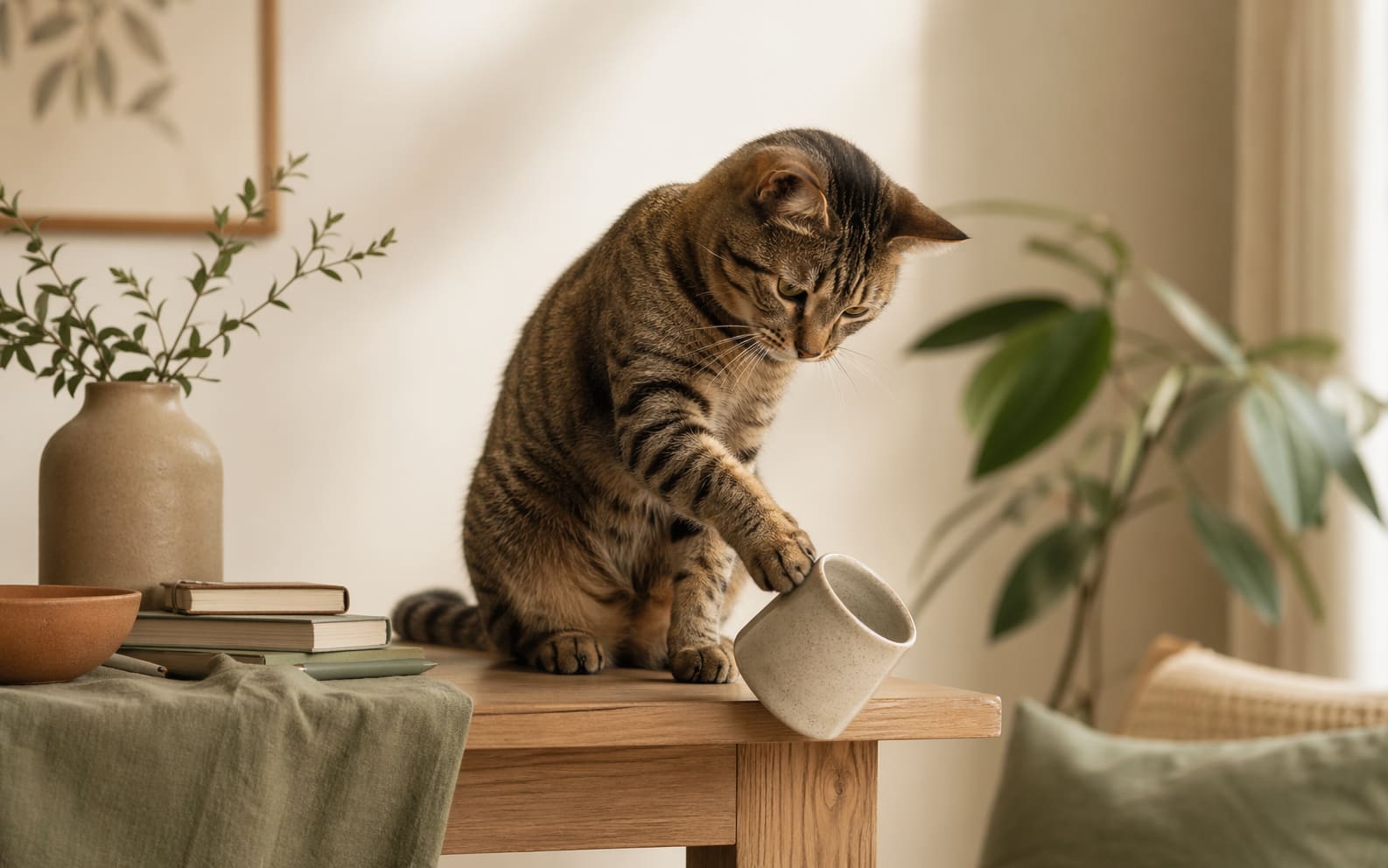
You’re sitting at your desk, minding your own business, when you hear it — the slow scrape of a glass being nudged toward the edge of the counter. You look up just in time to see your cat make eye contact with you, extend one deliberate paw, and send your favorite mug crashing to the floor.
Sound familiar?
If you live with a cat, you’ve experienced some version of this scene. And while it might feel like your cat is doing this purely to mess with you, the truth is more interesting — and honestly, more fixable — than you’d think.
Here’s what’s really going on, and what you can do about it.
1. It’s a Hunting Instinct (Not Spite)
Cats are hardwired predators. In the wild, they use their paws to test whether prey is still alive — batting at it to check for movement before going in for the catch.
When your cat nudges a pen, a remote, or a glass on your nightstand, they’re running the same instinctive program. The object wobbles, slides, or falls — and that movement triggers the same dopamine rush they’d get from catching a mouse.
Small, lightweight objects are especially irresistible. Pens, hair ties, bottle caps — anything that rolls or bounces after it falls becomes an instant toy.
What helps: Give your cat an outlet for that prey drive. Interactive wand toys that mimic the movement of birds or mice are a strong way to satisfy this instinct. Even 10–15 minutes of active wand play per day can make a noticeable difference.
2. Your Cat Is Bored
This is the big one. A cat with nothing to do will create their own entertainment — and your countertops become the playground.
Indoor cats especially need mental stimulation. Without it, they’ll turn to whatever’s available: pushing things off shelves, shredding toilet paper, or yowling at 3 AM.
What helps: Puzzle feeders are a game-changer here. Instead of dumping kibble in a bowl, these force your cat to work for their food — which engages their brain and burns energy at the same time. The Catit Senses Digger is a popular option that most cats take to immediately.
A multi-level cat tree near a window also works wonders. It gives your cat a vantage point to watch birds and survey their territory — which is basically cat Netflix.
See our full guide to indoor cat enrichment ideas →
3. They’re Trying to Get Your Attention
Here’s the uncomfortable truth: if you’ve ever yelled, laughed, or rushed over when your cat knocked something off a table — you’ve trained them to do it again.
Cats are sharp observers of cause and effect. They learn very quickly that “push glass → human reacts” is a reliable way to get attention. Even negative attention (yelling “NO!”) counts as a reward in their mind.
It’s the same reason some cats meow loudly at 5 AM. It worked once, so they keep doing it.
What helps: The hardest but most effective fix — don’t react. When something falls, resist the urge to look at your cat, yell, or rush over. Pick it up later, after they’ve lost interest.
Instead, reward the behavior you do want. When your cat is sitting calmly, playing with their own toys, or using their scratching post — that’s when they get your attention, treats, and praise.
4. They’re Exploring Their World
Cats experience the world through their paws. Unlike dogs who explore with their mouth, cats use their sensitive paw pads to investigate unfamiliar objects — testing texture, weight, and movement.
A new book on the coffee table? Your cat isn’t trying to destroy it. They’re gathering information: How heavy is this? Does it move? What happens if I push it?
This is especially common when you bring something new into the home. New items are basically cat magnets.
What helps: Give your cat safe things to investigate and manipulate. Treat-dispensing balls let them bat, push, and roll something that actually rewards their curiosity — instead of your coffee mug.
5. They Want a High Vantage Point (And Your Stuff Is in the Way)
Cats are vertical creatures. They feel safest when they can survey their territory from above. If the highest spot in your room is your desk, nightstand, or kitchen counter — that’s where your cat will go.
The objects up there? Just obstacles in their territory. They’re not being vindictive. They’re just clearing the deck.
What helps: Give them their own high spot. A tall cat tree (at least 40 inches, ideally 60+) with wide, sturdy platforms gives large cats the elevation they crave without turning your furniture into a war zone.
For items you can’t move, museum putty is an underrated trick — a small dab keeps vases, picture frames, and decorative objects anchored to the surface. Invisible, removable, and surprisingly effective.
The Bottom Line
Your cat isn’t a jerk. They’re a predator living in a world full of lightweight objects and flat surfaces — basically an irresistible playground.
The pattern behind almost every case of table-clearing is the same: not enough stimulation, not enough play, and too much reward when it happens.
The fix isn’t punishment (which doesn’t work and damages trust). It’s giving your cat better options: daily interactive play, puzzle feeders for mental stimulation, vertical space to climb, and ignoring the behavior when it happens.
For many cats, adding 15 minutes of structured play per day can reduce this behavior within a week or two. Your mug collection will thank you.
Struggling to keep track of your cat’s play habits? We’re building CatPlay — a simple app that helps you build a daily play routine and actually see the difference it makes in your cat’s behavior. Coming soon.
Sources
This article cites 3 sources in the text. They are linked below.
- How Cats Learn (FelineVMA)
- 2025 Meeting the Physical and Emotional Needs of Indoor Cats (FelineVMA)
- What Your Cat Needs to Feel Secure (Cat Friendly Homes)
Common questions
Why does my cat knock things off the table while looking at me?
Often because the behavior gets a reaction. If your cat has learned that pushing an object makes you look, speak, or get up, the table becomes a reliable way to get attention.
Do cats knock things over out of spite?
No. The more common drivers are prey play, boredom, curiosity, attention seeking, and the desire to clear space on a preferred perch.
What is the fastest way to reduce this behavior?
Daily interactive play, more climbing space, and less reinforcement when it happens usually matter most. The goal is to make the behavior less rewarding and give the cat better outlets.
The Cat Behavior Decoder
A free PDF with the body language cues and behavior patterns worth noticing first.
No spam. Unsubscribe anytime. We respect your inbox.