Why Your Cat Wakes You Up at 3 AM (And How to Stop It)
It's not random, and it's not malice. Cats wake their humans at night for three specific reasons — each with a fix that doesn't involve closing them out of the bedroom.
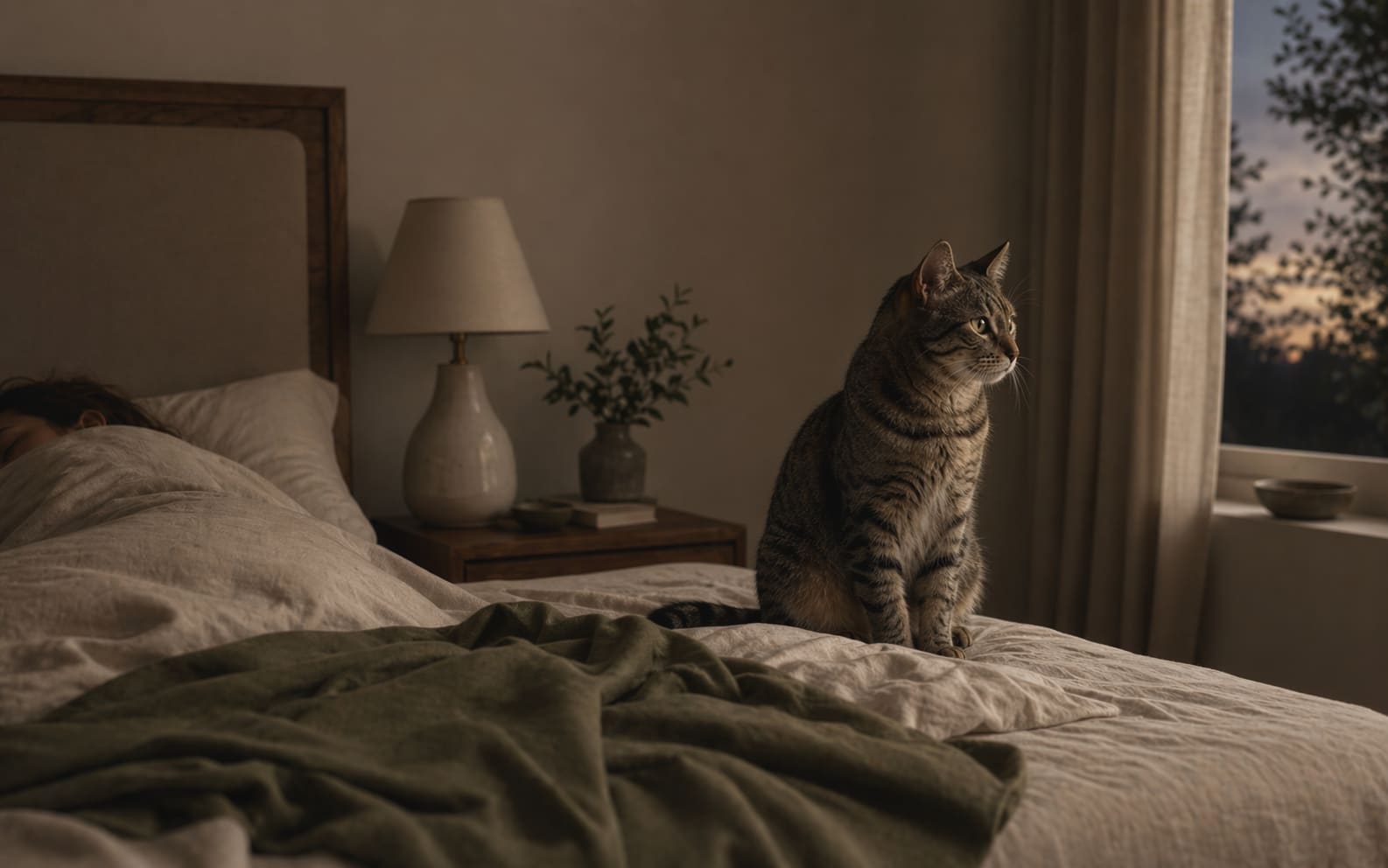
TL;DR: Cats wake you at night for three reasons: hunger pattern mismatch, under-stimulation, or attention-seeking that you’ve accidentally rewarded. The fix is almost never “lock them out” — it’s adjusting their day to match their biology.
If you’ve ever been startled awake at 3 AM by a paw on your face, a sprint across the bed, or the sound of something being deliberately knocked off a shelf — you’re not alone. Night activity is one of the most common complaints from indoor cat owners.
It’s also one of the most fixable behaviors once you understand what’s actually driving it.
The biology your cat is operating on
Cats are crepuscular — most active at dawn and dusk. Wild cats hunt small prey at these times, eat what they catch, groom, and sleep. The cycle is: hunt → eat → groom → sleep.
Modern indoor life breaks this cycle in three specific ways. Each break creates a different version of “3 AM cat.”
Reason 1: The food clock is wrong
If your cat eats dinner at 6 PM, they’re done digesting by 11 PM and entering the most natural hunting window of their biology — exactly when you want to sleep.
The fix: Move the largest meal of the day to right before bed. This triggers the natural post-meal grooming and sleep cycle at the time you actually want them to sleep.
If your cat free-feeds (food always available), this is harder to manage. Switch to scheduled meals — two a day, with the second meal as late as possible. If you’re feeding dry food, a PetSafe SlimCat can turn part of that bedtime meal into a short forage session instead of a 30-second inhale.
Reason 2: They’re under-stimulated
A cat who has been alone all day, with no real play and no novelty, has a full tank of unspent energy. By 3 AM, that energy has to go somewhere.
This is the most common cause, and the easiest to fix.
The fix: A 10–15 minute structured play session in the evening, ideally 30–60 minutes before bedtime. Use a wand toy. Make them actually run, stalk, and pounce. The goal is to exhaust them, not just entertain them. Go Cat Da Bird is still one of the best options for getting a genuine chase session instead of half-hearted batting.
After the play session, feed them. This recreates the natural hunt-eat-sleep sequence.
See our enrichment guide for more ideas →
Reason 3: You’ve accidentally trained them
This one stings, but it’s the most common reason for persistent night waking.
The first time your cat woke you up, what did you do? Most people, half-asleep, did one of three things: got up to feed them, opened the bedroom door, or scratched their head until they left.
Congratulations — you’ve just trained them that 3 AM yelling produces a result.
Cats are extremely good at noticing what works. If a behavior gets a response even sometimes, they will repeat it. This is called intermittent reinforcement, and it’s the strongest form of behavioral conditioning that exists.
The fix: Stop responding. Completely. For two to three weeks. No food, no door opening, no acknowledgment. The behavior will get worse before it gets better — this is called an “extinction burst,” and it’s the sign you’re on the right track.
If you respond even once during the extinction burst, you’ve reset the entire training, and you’ll have to start over.
What to do tonight
Three changes, in this order:
- Move the biggest meal of the day to right before your bedtime. This alone solves it for many cats.
- Add a 10-minute play session before that meal. Use a wand toy. Make them work.
- Stop responding to night waking. Completely. The first week will be brutal. The second week, you’ll see the change.
When it’s actually a health issue
If a previously quiet cat suddenly starts night waking — especially with vocalization — it’s worth a vet check. Sudden changes in vocalization or activity in older cats can signal hyperthyroidism, cognitive decline, or pain. The patterns above describe healthy cats whose biology is just out of sync with their owners’ schedules.
If you’ve made the three changes above and seen no improvement in three to four weeks, it’s worth calling the vet.
For most cats, though, the 3 AM cat is a problem you accidentally created — and one you can deliberately untrain. The cycle exists for a reason. Match your evenings to it, and your nights get quiet.
Sources
This article cites 3 sources in the text. They are linked below.
- How Cats Learn (FelineVMA)
- 2025 Meeting the Physical and Emotional Needs of Indoor Cats (FelineVMA)
- What Your Cat Needs to Feel Secure (Cat Friendly Homes)
Common questions
Why does my cat wake me up at 3 AM every night?
The usual reasons are a mismatched food schedule, too little stimulation during the day, or night waking that has been reinforced by attention, food, or door opening.
Should I ignore my cat when they wake me up at night?
If the pattern is behavioral and your cat is otherwise healthy, consistency matters. Responding sometimes can keep the behavior going, so ignoring it works best when paired with better evening play and feeding routines.
When is night waking a vet issue?
A sudden change, especially in an older cat or alongside increased vocalization, appetite changes, confusion, or restlessness, is a reason to call your vet.
The Cat Behavior Decoder
A free PDF with the body language cues and behavior patterns worth noticing first.
No spam. Unsubscribe anytime. We respect your inbox.